Your AI Solution Probably Isn’t the Problem
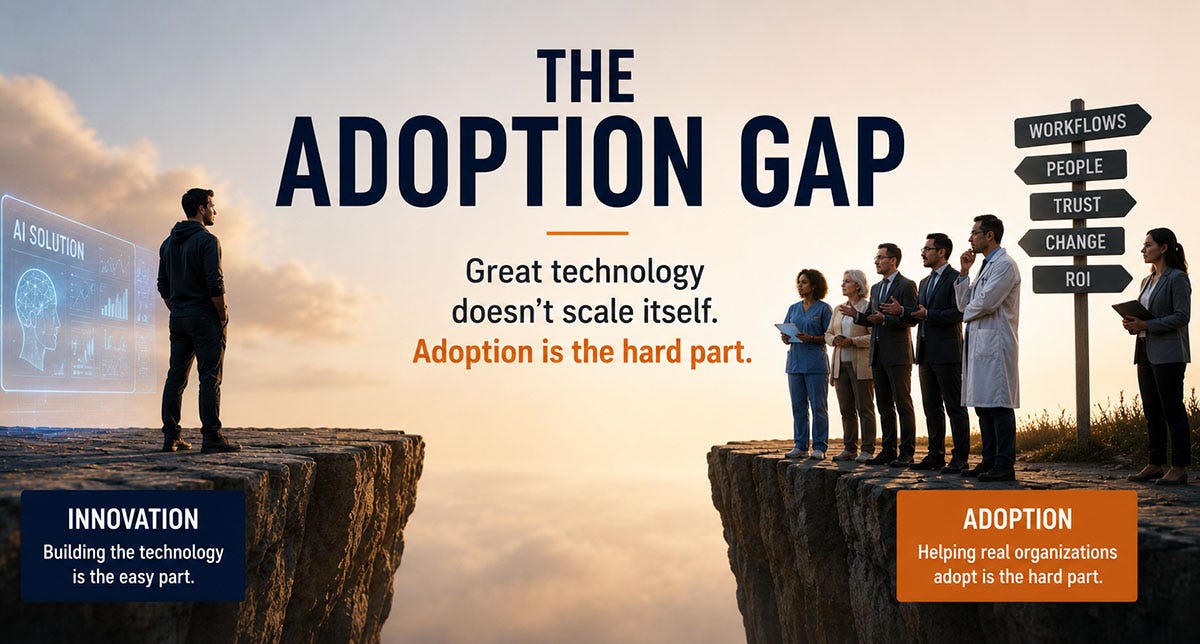
Most AI companies don’t struggle with innovation. They struggle with adoption.

Over the past several months, I’ve spent time talking with founders, operators, investors, and innovators across AI, healthcare, and AgeTech. The pattern keeps repeating itself.
Technology works.
Demos impress people.
Pilots create excitement.
Then growth slows down.
Not because the product failed.
Because the market never fully absorbed the change the product required.
I’m seeing companies with funding, partnerships, technical teams, and real innovation still struggle to move beyond early traction. Many leadership teams quietly discover the same uncomfortable truth:
Building the technology was the easy part.
Helping organizations adopt it and scale is the real challenge.
Early Momentum Can Be Misleading
Many founders mistake:
investor interest
pilot programs
conference visibility
first customers
for market readiness.
They are not the same thing.
Early adopters tolerate friction because they believe in innovation. Mainstream healthcare and AgeTech markets do not. These organizations already operate under staffing pressure, financial constraints, operational fatigue, and constant change.
Anything that feels difficult to implement, risky to explain, or disruptive to workflow immediately creates resistance.
That changes the entire commercialization equation.
AI Alone Does Not Create Adoption
Many leadership teams still believe stronger technology naturally wins markets.
That rarely happens in healthcare or AgeTech.
Organizations adopt solutions when leadership reduces friction and creates trust.
In these markets, buyers need:
operational clarity
confidence in implementation
proof the solution fits existing workflows.
Without those elements, even strong products struggle to scale.
That is why so many AI companies stall after early traction. Leadership teams continue improving features while adoption problems quietly grow in the background.
Commercialization Is Becoming the Real Differentiator
Many emerging companies aggressively fund:
engineering
development
product expansion.
Then treat commercialization and adoption strategy as secondary work.
That approach becomes expensive as organizations attempt to scale.
AI in healthcare seldom fails through technology alone. These ecosystems involve emotional decisions, operational realities, fragmented stakeholders, and trust-sensitive environments.
The companies that scale successfully help customers make sense of change.
That requires:
stronger partnerships
clearer positioning
simpler implementation.
Commercialization is no longer support work.
This is the work of leadership!
The Hard Question
Most organizations ask:
“Can we build this?”
Far fewer ask:
“Can the market realistically absorb this?”
Those questions create very different outcomes.
One creates innovation.
The other creates scalable businesses.
The Real Opportunity
The next wave of winners in AI, healthcare, and AgeTech may not build the most advanced technology.
They may become the companies that:
simplify adoption
reduce operational friction
align ecosystems
help organizations navigate change with confidence.
Technology creates attention.
Adoption creates markets.
Call to Action
Most AgeTech companies do not need more excitement around innovation.
They need a stronger adoption strategy.
The companies pulling ahead right now are not simply building better technology. They are helping overwhelmed organizations adopt change with less friction, less confusion, and greater confidence.
That requires leadership teams to start asking different questions:
Does our solution fit naturally into the customer’s operational reality?
Have we made adoption easier for the people expected to use it every day?
Where will resistance emerge inside the organization?
Do our partnerships simplify implementation or create more complexity?
Are we reducing uncertainty for buyers or adding to it?
Have we invested as seriously in adoption as we have in product development?
Technology may open the door.
Adoption determines whether the market walks through it.
What do you think? Have you seen similar challenges? What did you do?